
Stop Wasting Billable Hours: The 8-Step AI Prompting Framework for Law Firms
Most legal AI prompts fail before the first word gets typed. Not because the model is weak. Because the lawyer skipped the setup.
The American Bar Association settled the stakes in Formal Opinion 512: lawyers using generative AI carry the same duties they always have: competence, confidentiality, communication, supervision, candor, meritorious claims and fees.
AI doesn't lower the bar. It raises the cost of skipping the fundamentals. Here's the gap.
A 2026 survey of legal professionals found 69% personally use generative AI at work. Only 28% use it daily. 43% of firms have no written AI policy and no plan to write one. 54% of firms offer no AI training and have no plans to implement it. Broad usage, almost no structure underneath it. That's not an adoption problem. That's a governance problem wearing an adoption costume.
Stanford RegLab tested this directly. Specialized legal research AI tools still produced incorrect information at rates above 17%, with Westlaw AI-Assisted Research exceeding 34% in the study. These weren't unguided consumer chatbots. These were purpose-built legal tools, and they still invented law at scale.
Thomson Reuters' 2025 Future of Professionals report drew the sharpest line: firms with a visible AI strategy were 3.5 times more likely to see measurable benefits, and nearly twice as likely to see AI-related revenue growth, compared to firms treating AI as an informal add-on.
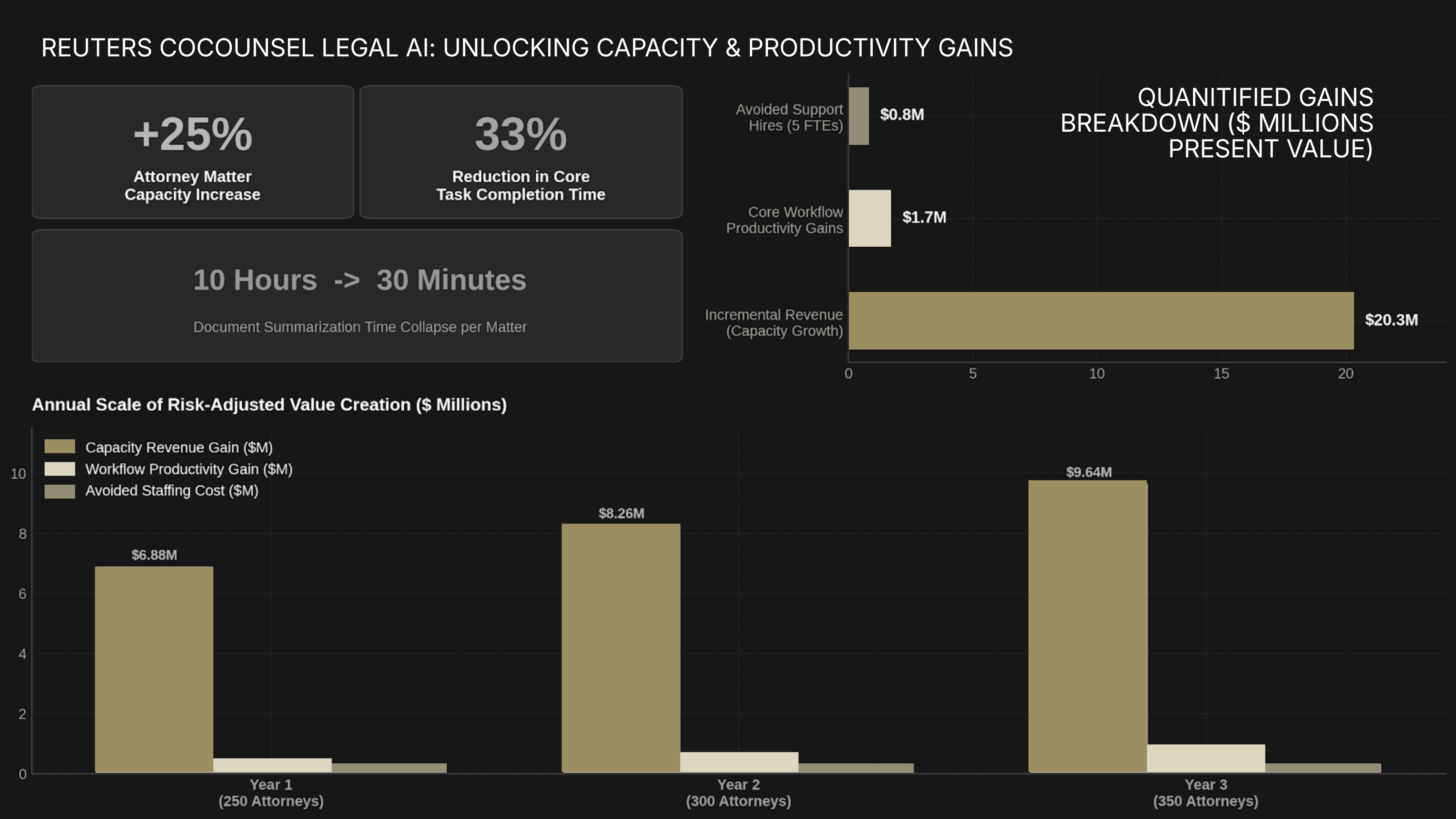
Read those four data points together. The tool isn't the differentiator. The structure around it is.
Context, Not Compute
Legal tech media obsesses over compute; which model is faster, larger, or cheaper this quarter. Compute is a commodity. Rent it anywhere for pennies.
Your firm's advantage is context: matter histories, house style, ethical boundaries, precedent. You already own it. The firms pulling ahead aren't buying better models. They're building a governed context layer: a structure that loads the right matter permissions, firm rules, and source material into every session automatically, instead of starting from zero every time.
State this plainly before you touch a prompt: AI does not carry your professional responsibility for the work product. Match your review to the task's actual risk.
Style ≠ reasoning. Confidence ≠ correctness. Familiarity ≠ verification.
The 8-Step Framework
Step 1: Set Hard Data Boundaries First
Most legal-AI guides skip this step. Decide what the AI is allowed to see before you optimize how you talk to it. Write a one-page AI policy this week if you don't have one.
Prompt: "Before using any client information, confirm this environment is approved for confidential data under our firm's AI policy. Do not include privileged, confidential, or personally identifying information unless our security, contractual, and client-consent requirements are already satisfied."
Step 2: Set Your Firm's Risk Baseline
An unconstrained model flags everything, because every deviation carries theoretical risk. That wastes partner time filtering noise instead of reviewing substance. Give it your actual threshold.
Prompt: "Flag anything a reasonable opposing counsel would actually push back on. Don't flag standard market terms just because they carry theoretical risk, confirm whether this specific matter changes that."
Step 3: Match Tone to the Reader
A letter to opposing counsel and an update to a frightened first-time client are not the same task, even when the legal substance is identical. Tell the AI who's reading before it drafts a word.
Prompt: "This client is a first-time defendant, already stressed, without legal background. Write like you're calming someone down, not briefing a colleague."
Step 4: Force Adversarial Stress-Testing
Make the model argue against you before it agrees with you. This surfaces weak points before they reach a filed document. It does not replace your own read, a fabricated-sounding rebuttal still needs your eyes.
Prompt: "Before drafting, identify the strongest credible counterarguments to this position, the authorities or facts that support them, and the assumptions our position depends on. Separate issues that could materially undermine us from issues that are merely theoretical."
Step 5: Feed It Real Writing, Not Adjectives
"Professional but approachable" produces nothing distinctive. Every firm's marketing already claims that. Real samples give the model a pattern to match instead of a vague label.
Prompt: "Here are three emails I've sent in similar situations. Match this phrasing, sentence length, and formality not just the tone I'm describing."
The model reproduces the pattern in your examples, not the judgment behind them. A mistake or an outdated position sitting in those samples gets copied, not corrected. Vet your examples before you feed them.
Step 6: Require Source Anchoring, Not Self-Reported Confidence
A model's claim that it's "confident" means nothing, it sounds equally certain when it's right and when it's fabricating. Don't ask it to grade its own uncertainty. Force it to show its work.
Prompt: "For every material factual or legal proposition, identify the exact source document and location supporting it. If no supplied source supports it, label it UNSUPPORTED. Do not manufacture or infer a citation."
Step 7: Front-Load the Point, Close With the Action
Kahneman's 1993 research found people's memory of an intense experience is shaped disproportionately by its peak and its ending. That study measured physical pain in a lab, not client letters but the mechanism transfers directly to written communication: what sits buried in paragraph four gets lost regardless of how accurate it is.
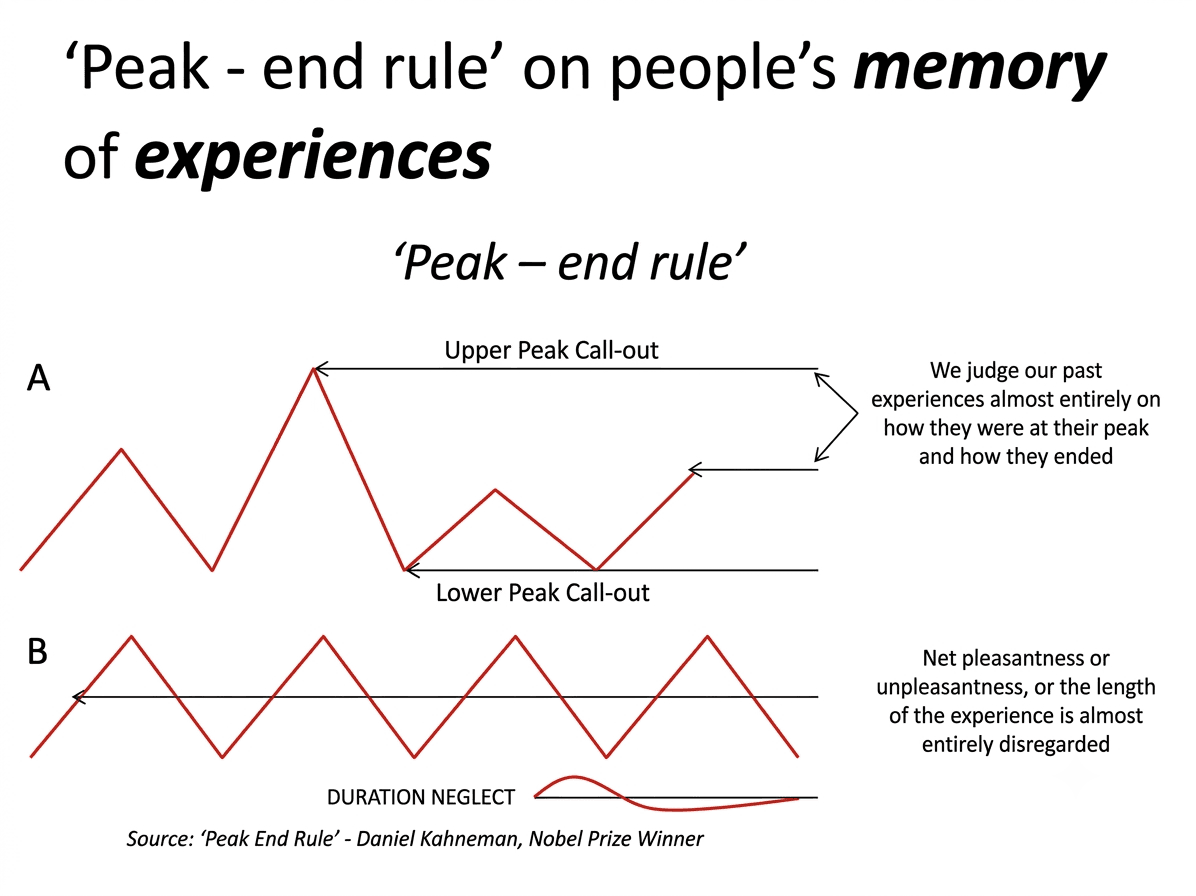
Prompt: "Lead with the most decision-relevant information, then next steps and timing, then the legal reasoning in enough detail for an informed decision. Put the most important point (good or bad) near the start or as the clear final line, not buried in the middle. End with one specific next action."
Step 8: Present Both Sides | Cut the Persuasion
Loss aversion is real. Ruggeri et al. (2020) replicated core prospect-theory patterns across 19 countries, with the size of the effect shifting by country. Real does not mean a license to steer. Framing every recommendation around what a client stands to lose turns education into pressure. Present both sides. Let the client's own risk tolerance make the call.
Prompt: "Explain both the potential benefits and potential losses of each material option. Do not use emotionally loaded framing to steer the client toward a particular choice."
The Risk of "Thinking Like You"
The more convincingly an AI output sounds like you, the easier it becomes to assume it reasoned the way you would. That assumption is backwards. A matched voice proves nothing about the judgment underneath it.
The target isn't AI that replaces your thinking. It's AI that produces output consistent with your standards when you give it real context, real decision criteria, and real source material with everything that can't be reduced to a rule still landing on your desk for review.
Run This Today
Pick one prompt already in rotation for client communication. Add Step 7 or Step 8. Compare the output to what the same prompt produces without it. Then send us your caseload. If your firm is buried and needs a contract attorney to carry it, not just draft faster, book a call with our team here.
Ciations
American Bar Association, Formal Opinion 512, "Generative Artificial Intelligence Tools" (2024). https://www.americanbar.org/groups/professional_responsibility/committees_commissions/committeeonethics20200/resources/formal-opinion-512-generative-artificial-intelligence-tools/
Stanford RegLab / Stanford Institute for Human-Centered AI, "Hallucination-Free? Assessing the Reliability of Leading AI Legal Research Tools" (2024). https://hai.stanford.edu/news/hallucinating-law-legal-mistakes-large-language-models-are-pervasive
Thomson Reuters, "2025 Future of Professionals Report." https://www.thomsonreuters.com/en/reports/future-of-professionals-report.html
Kahneman, D., Fredrickson, B. L., Schreiber, C. A., & Redelmeier, D. A. (1993). "When More Pain Is Preferred to Less: Adding a Better End." Psychological Science, 4(6), 401–405. https://journals.sagepub.com/doi/10.1111/j.1467-9280.1993.tb00589.x
Redelmeier, D. A., & Kahneman, D. (1996). "Patients' Memories of Painful Medical Treatments: Real-Time and Retrospective Evaluations of Two Minimally Invasive Procedures." Pain, 66, 3–8.
Kahneman, D., & Tversky, A. (1979). "Prospect Theory: An Analysis of Decision Under Risk." Econometrica, 47(2), 263–291.
Ruggeri, K., et al. (2020). "Replicating Patterns of Prospect Theory for Decision Under Risk." Nature Human Behaviour. https://www.nature.com/articles/s41562-020-0886-x
Further Reading
Stay informed on immigration case strategy and firm operations.
Instagram · LinkedIn · Facebook
OPERATIONS
Stop Wasting Billable Hours: The 8-Step AI Prompting Framework for Law Firms
OPERATIONS
Firm Operations
The AI Operating System Most Law Firms Are Missing
78% of law firms have no AI strategy, they just own AI tools. Here's what actually separates the two, and what the firms pulling ahead are doing that most partners haven't even considered.

